
GitHub Copilot HydraFusion Routes Coding Tasks Across Models to Cut Cost Up to 67%
GitHub’s Project HydraFusion research preview in Copilot CLI builds single, cascade, or critique workflows across models, cutting estimated cost versus Claude Opus 5 on three benchmarks while matching or beating quality on only one of them.
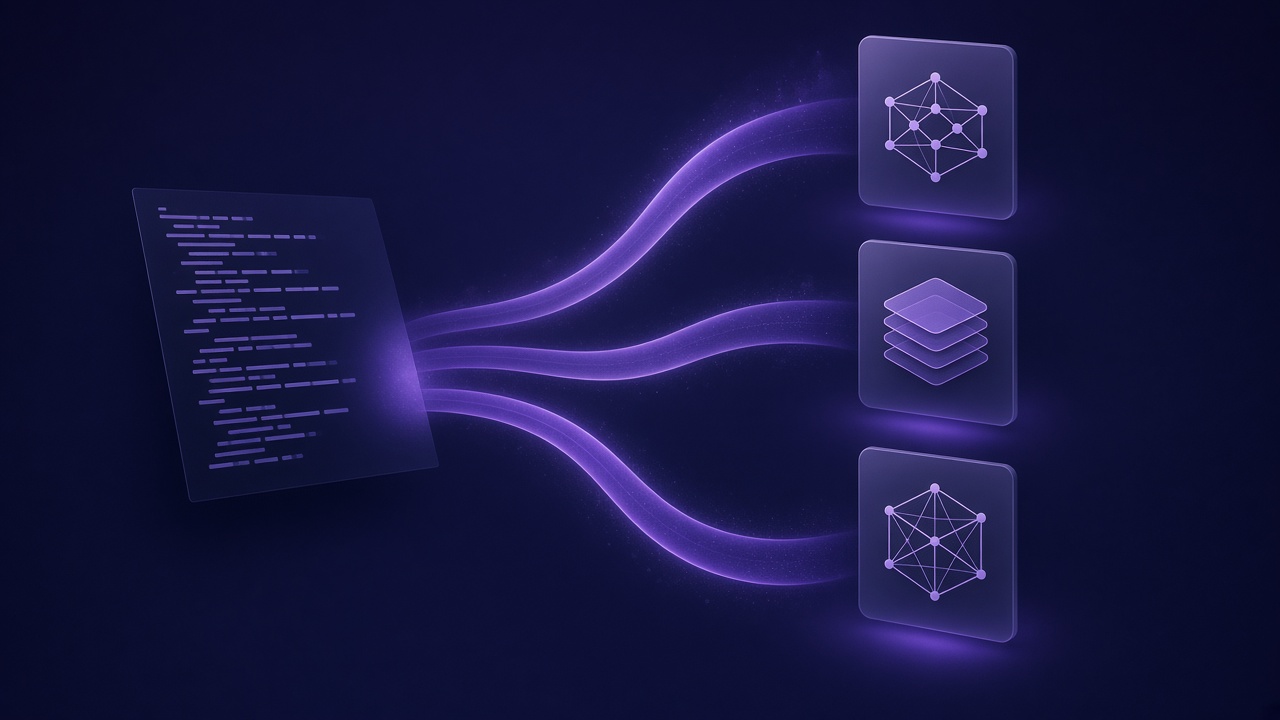
GitHub introduced Project HydraFusion on September 4, 2026, as a research preview that treats coding-agent execution as a runtime orchestration problem rather than a single-model pick. The GitHub Blog announcement and VentureBeat’s same-day analysis describe a Copilot CLI preview that chooses among Single, Cascade, and Critique patterns before any model call, then bills usage at each underlying model’s standard token rate.
HydraFusion sits beside Auto model selection. Auto picks one model for a task; HydraFusion builds a workflow that may draft, escalate, or critique across providers. Developers select HydraFusion like any other model via /experimental in Copilot CLI (/update, /experimental on, then /model → HydraFusion Research Preview). The preview is available on all Copilot plans.
Three execution patterns
For each request, HydraFusion currently chooses one of three patterns. Single sends the task to one model with no extra review. Cascade lets an efficient model draft first, then a quality gate accepts the draft or escalates to a stronger model. Critique has one model draft, an independent read-only critic from a different model family review the result in an isolated tool-less context, and the drafting model revise once. GitHub frames the choice as an optimization over reasoning, code generation, debugging, and tool-use capability signals.
Operating principles in the GitHub Blog include complete cost accounting across every workflow leg, bounded timeouts, isolated review that cannot modify the repository, fail-safe application of no patch on cancel or validation failure, and preflight checks of workflow definitions and model availability.
What the benchmarks actually show
In controlled offline evaluations against Claude Opus 5 (and GPT-5.6 Sol as another baseline), GitHub’s best tuned HydraFusion configuration reported:
- TerminalBench 2.1: +4.9 percentage points verified quality at 67% lower estimated cost
- DeepSWE: −1.5 points at 36% lower cost
- CheckpointBench (internal Copilot-session trajectories): −0.1 points at 65% lower cost
Cost fell on every row. Quality matched or exceeded Opus 5 on one of three. VentureBeat highlights that gap against marketing that frames HydraFusion as delivering frontier-level quality across the board. GitHub notes the preview is strongest today on first-turn, single-prompt coding tasks, with multi-turn orchestration still in development, and that results may change as the research preview learns from real workloads. Primary sources are the GitHub Blog HydraFusion post and VentureBeat’s September 4 analysis.
- #Products
- #AI Agents
- #Opensource

Author
Raj M
Contributor
AI Systems Architect is a seasoned technology leader with over 15 years of experience in the IT industry working with Fortune 500 companies. With a solid foundation in multi-agent systems, open-source LLM infrastructure, and enterprise deployment, he excels at building scalable production-grade AI platforms.