
Runway Opens Praxis-1's 27B World-Action Weights Under Apache 2.0 After Partner Robots Already Ran Them
Runway released Praxis-1 on November 11, 2026 as an Apache-2.0 open-weight 27B mixture-of-experts diffusion transformer that predicts video and robot actions together, topping NVIDIA's RoboLab-120 at 46.2% success across 1,200 episodes, with weights on Hugging Face and code on GitHub.
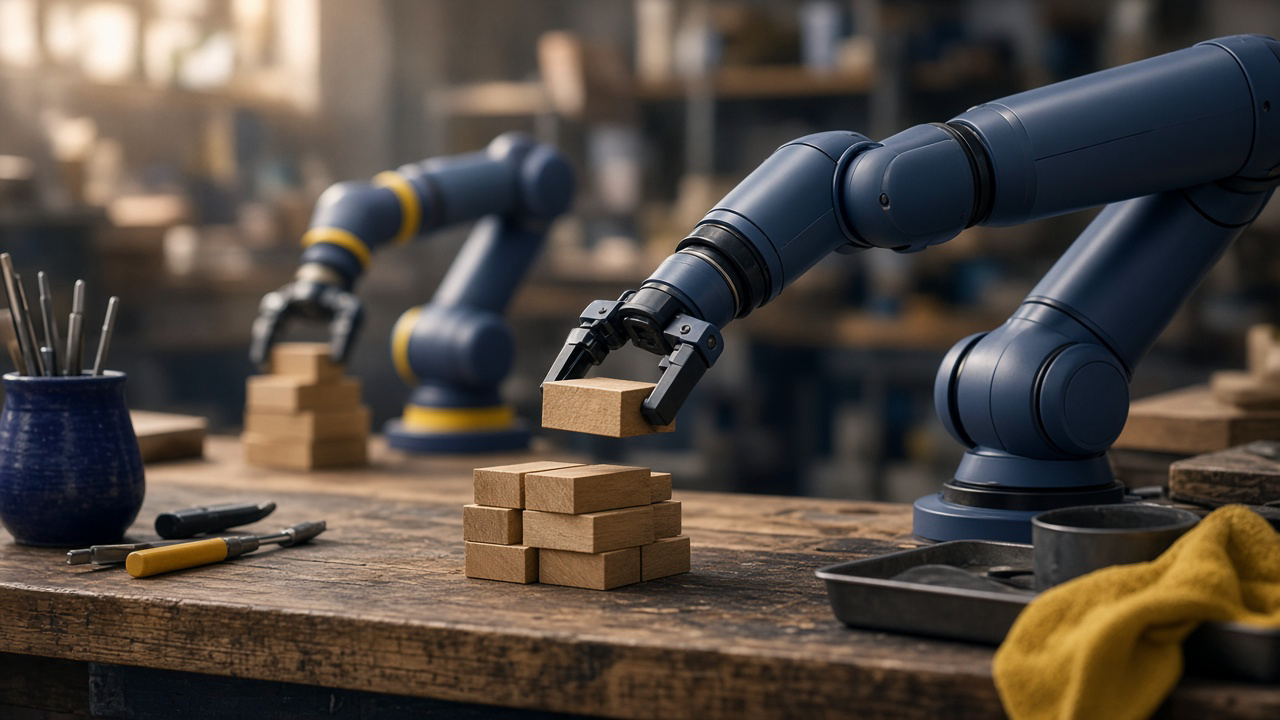
Runway has opened the weights of Praxis-1, the world-action model it first showed partners in September, under the Apache 2.0 license. The company posted the availability note on November 11, 2026. Launch partners Noble Machines, Standard Bots and Ultra had already been running the same checkpoint on their own hardware — a legged humanoid, a six-axis industrial arm and a dual-arm warehouse robot — before the public release.
Praxis-1 is a video-action policy: for each call it predicts the next video chunk and the next action chunk together. Runway says it is built on the same large-scale video pretraining behind its general world models. The pitch to robotics developers is that web video can match teleoperated robot video as pretraining data, so the bottleneck shifts to how much general video a model can learn from before anyone fine-tunes it on a particular arm.
A 27B MoE that predicts motion and footage
The Hugging Face model card for runwayml/praxis-1-base describes a 27.2-billion-parameter mixture-of-experts video-diffusion policy: a chunk-causal trunk plus a 0.3B action expert. Frozen dependencies that are not in the Praxis checkpoint are the Wan2.2 VAE and the Qwen/Qwen3.5-2B text encoder; both ship under their own licenses. Control is 15 Hz with 24-step action chunks. The bf16 weights are about 54.4 GB across 17 safetensors shards.
The base checkpoint has no per-embodiment action heads, so it does not run as a policy as-is. Runway publishes ready fine-tunes for a single-arm DROID rig (praxis-1-droid) and a bimanual YAM setup (praxis-1-yam), plus LeRobot-layout and NVFP4 variants. On the DROID card, Runway reports 52.5% full adherence on its own autoregressive prompt-adherence set, with a 95% confidence interval of 35.8–68.3%. Inference for that checkpoint needs one 80 GB GPU.
Where it sits on RoboLab-120
Runway’s announcement table puts Praxis-1 at the top of NVIDIA’s RoboLab-120 leaderboard among the models it lists, with 46.2% success across 1,200 episodes as of November 2026. The same table shows FLUX 3 Action at 42.9%, Cosmos3 Nano at 36.8% and π0.5 at 28.0%. Runway also says Praxis-1 outperforms every open-weight vision-language-action model it compared. Those rankings should be read as company-reported.
For transfer, Runway says a single Praxis-1 checkpoint has adapted to several embodiments with light fine-tuning. Fine-tuned on Google’s RT-1 robot, which never appeared in its training data, Praxis-1 reaches 80.0% success on SimplerEnv, against 52.4% for the original RT-1 policy, according to Runway.
What actually shipped under Apache 2.0
Weights are on Hugging Face under the runwayml org; the reference code lives in runwayml/praxis-1-oss on GitHub, licensed Apache-2.0. The repository covers inference, serving, fine-tuning and LoRA. Hosted inference is available on Runway’s Reactor. The company says the stack runs across NVIDIA hardware from H100 and B200 data-center GPUs to RTX 5090 and RTX PRO 6000 workstations and Jetson Thor on the robot. Native LeRobot support and vLLM-Omni are listed alongside full fine-tuning and LoRA paths.
The open-source README’s quick start is concrete about the floor: Python 3.12, one CUDA GPU with at least 80 GB of memory, and the CUDA 13.0 driver. A first run downloads Wan2.2 VAE weights, Qwen3.5-2B and the DROID checkpoint, then can drive a MuJoCo simulation of tasks such as block_in_bowl.
Why Runway is opening it
When Praxis-1 was announced, Runway committed to shipping it as an open model. The November note frames that choice as part of U.S. leadership in physical AI and points to Runway’s role as a founding member of the Cosmos Coalition with NVIDIA. Open weights, it argues, let hardware developers run, inspect and adapt a world-action model on their own terms, including for commercial use under Apache 2.0.
The release sits next to other open world-model work this week, but its angle is different: not simulating “what if” scenes for agents, but outputting the motor commands a robot should take next. Developers who want a new embodiment still have to add action heads and fine-tune; what they no longer need is a closed partner program to start.
- #Runway
- #Praxis-1
- #Robotics
- #Open Weights
- #Apache 2.0

Author
Raj M
Contributor
AI Systems Architect is a seasoned technology leader with over 15 years of experience in the IT industry working with Fortune 500 companies. With a solid foundation in multi-agent systems, open-source LLM infrastructure, and enterprise deployment, he excels at building scalable production-grade AI platforms.