
I2-CISSP Machine Learning Framework Predicts Cisplatin Chemotherapy Response with Dual Interpretability
Researcher Mythreya Dharani has presented I2-CISSP, an interpretable machine learning model designed to predict whether human tumors will respond to cisplatin chemotherapy. Evaluated on clinical records from The Cancer Genome Atlas and tested on the independent OCCAMS cohort, the
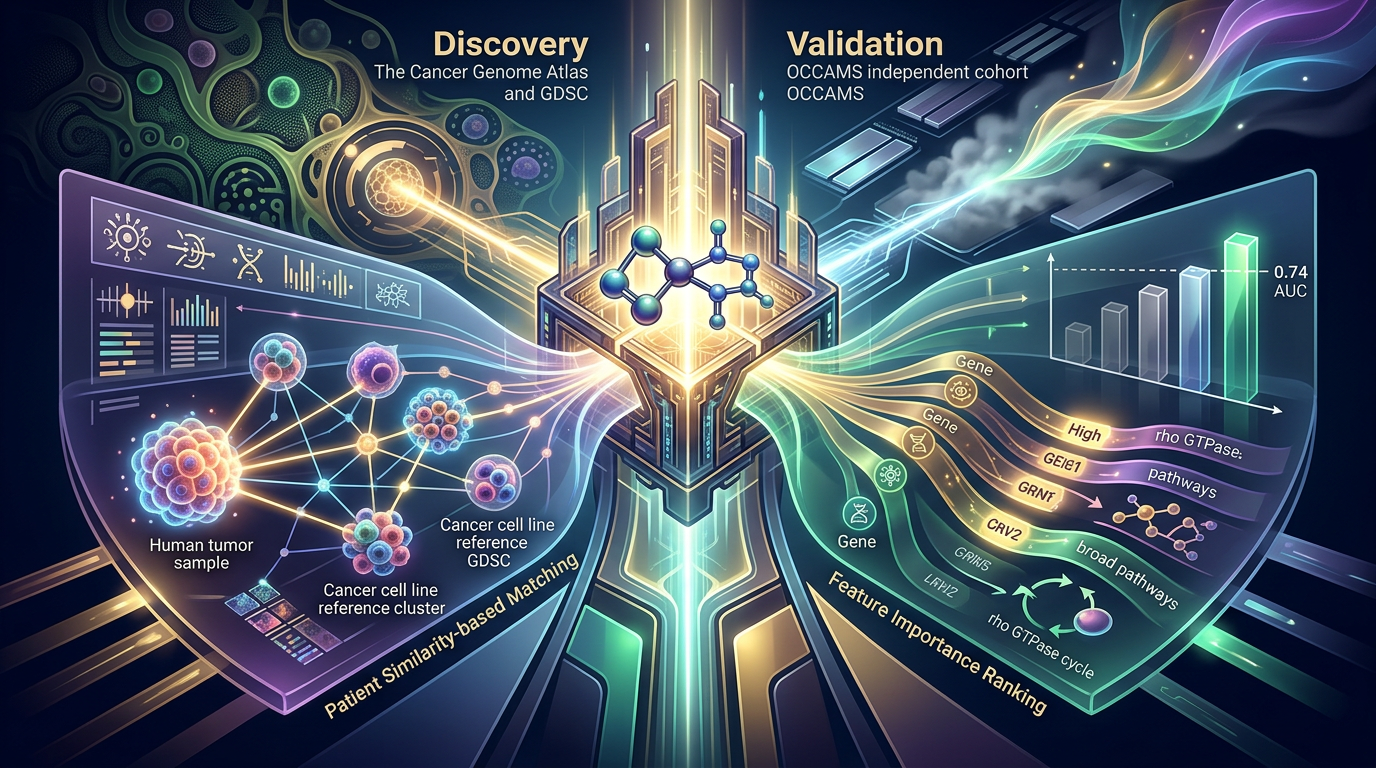
Researcher Mythreya Dharani has presented I2-CISSP, an interpretable machine learning model designed to predict whether human tumors will respond to cisplatin chemotherapy. Evaluated on clinical records from The Cancer Genome Atlas and tested on the independent OCCAMS cohort, the model achieved an Area Under the Curve accuracy score of 0.74, outperforming traditional linear baselines while generating biological explanations for its clinical predictions.
Chemotherapy response prediction tools often rely on complex architectures that function as black boxes, obscuring why a particular sensitivity or resistance classification was made. The I2-CISSP framework addresses this issue by pairing patient gene expression data with cancer cell line profiles, generating predictions alongside two distinct explanatory readouts for clinicians.
Dual-Source Training and Cross-Cohort Validation
The framework relies on two distinct biological datasets to build its predictive features:
- The Cancer Genome Atlas (TCGA): Gene expression measurements and binary cisplatin response records from 273 human tumor samples.
- Genomics of Drug Sensitivity in Cancer (GDSC): Baseline gene expression data and half-maximal inhibitory concentration (IC50) cisplatin response values across 722 cancer cell lines.
During model construction, the pipeline extracts tumor-derived gene expression features alongside tumor-to-cell-line similarity metrics. The system then merges these feature sets and trains predictive models using a leave-one-out cross-validation workflow.
Following initial training, the fully trained I2-CISSP model was tested against an unseen validation cohort from the OCCAMS dataset comprising 37 patient samples.
Predictive Performance Against Baseline Algorithms
Across the primary evaluation cohort, I2-CISSP recorded an Area Under the Curve (AUC) of 0.74. This performance represented an 8% improvement over standard single-dataset and linear baseline models evaluated in the research.
The evaluation benchmarked I2-CISSP against multiple modeling configurations:
- Elastic Net, Lasso, and Ridge Regression models trained on the CisSig gene signature.
- Elastic Net, Lasso, and Ridge Regression models trained on an expanded CisSig variant (CisSig*).
- Standalone Elastic Net models trained solely on GDSC cell line data or TCGA tumor data.
- Ablation variants isolating either expression features or similarity features alone.
In comparative tests, models relying solely on cell line data or single gene expression signatures scored lower AUCs than the integrated I2-CISSP pipeline.
Dual Interpretability Mechanisms
To provide transparent decision-making, I2-CISSP produces two separate forms of model interpretation: patient similarity matching and feature importance ranking.
Patient Similarity-Based Interpretation
The first interpretive layer compares a patient’s tumor expression profile directly against reference cell lines within the GDSC database. The system identifies cell lines that share the closest molecular distance to the patient’s tumor.
This mechanism allows medical teams to check whether a tumor classified as sensitive or resistant aligns with cell lines from the same cancer type. For example, in lung adenocarcinoma (LUAD) test cases, accurate classifications showed close alignment with LUAD cell lines such as NCI-H1838, NCI-H1563, and NCI-H2023. Conversely, classifications that matched mismatched cancer types—such as melanoma (SKCM) or glioblastoma (GBM)—helped identify potential classification errors.
Feature Importance-Based Interpretation
The second layer analyzes the specific mathematical coefficients assigned to individual genes and molecular pathways during prediction.
The framework assigns positive and negative weights across thousands of genes, highlighting biological pathways such as the KEGG Pathways in Cancer and the Reactome Rho GTPase cycle. Clinicians can review these weights to verify whether the classification is driven by known mechanisms of drug action.
Laboratory and Literature Validation of Target Genes
The research evaluated the biological plausibility of the highest-weighted genes identified by I2-CISSP through scientific literature review and laboratory experiments on control and cisplatin-treated A375 cell lines.
The analysis identified and validated several specific genes:
- ZFP36: Previously linked to cisplatin response in two cancer types through BCL2 downregulation and oncogenic mRNA degradation; validated in vitro via quantitative PCR (qPCR).
- MT1G: Previously documented to bind heavy metals and inactivate cisplatin.
- C4A: A gene with no prior documented link to cisplatin resistance; validated in vitro using next-generation sequencing.
- PTPRF: Partially documented in prior studies involving cisplatin damage to protein tyrosine phosphatases via covalent adducts; validated in vitro through next-generation sequencing.
- ZNF853: Partially linked in prior cell line literature where cisplatin alters expression; validated in vitro via next-generation sequencing.
Laboratory validation confirmed that novel and partially documented genes prioritized by the framework exhibited altered expression following cisplatin exposure in cell cultures.
- #Opensource

Author
Krishnan
Contributor
Enterprise Technology Explorer is a business and operations professional with over 15 years of experience across multiple industries working with Fortune 500 companies. With a solid foundation in enterprise processes, digital adoption, and technology evaluation, he excels at bridging business needs with emerging technologies to build scalable enterprise-grade applications.