
Physicl Raises $10M to Rebuild the Rare Scenes Where Robots Fail, Thousands of Times Over
On November 6, 2026 Paris- and Bay Area-based Physicl announced a $10 million seed round led by Inovia Capital with US Venture Partners and launched Studio, a beta app that generates labeled 3D variations of the edge cases that trip up robotics and world models.
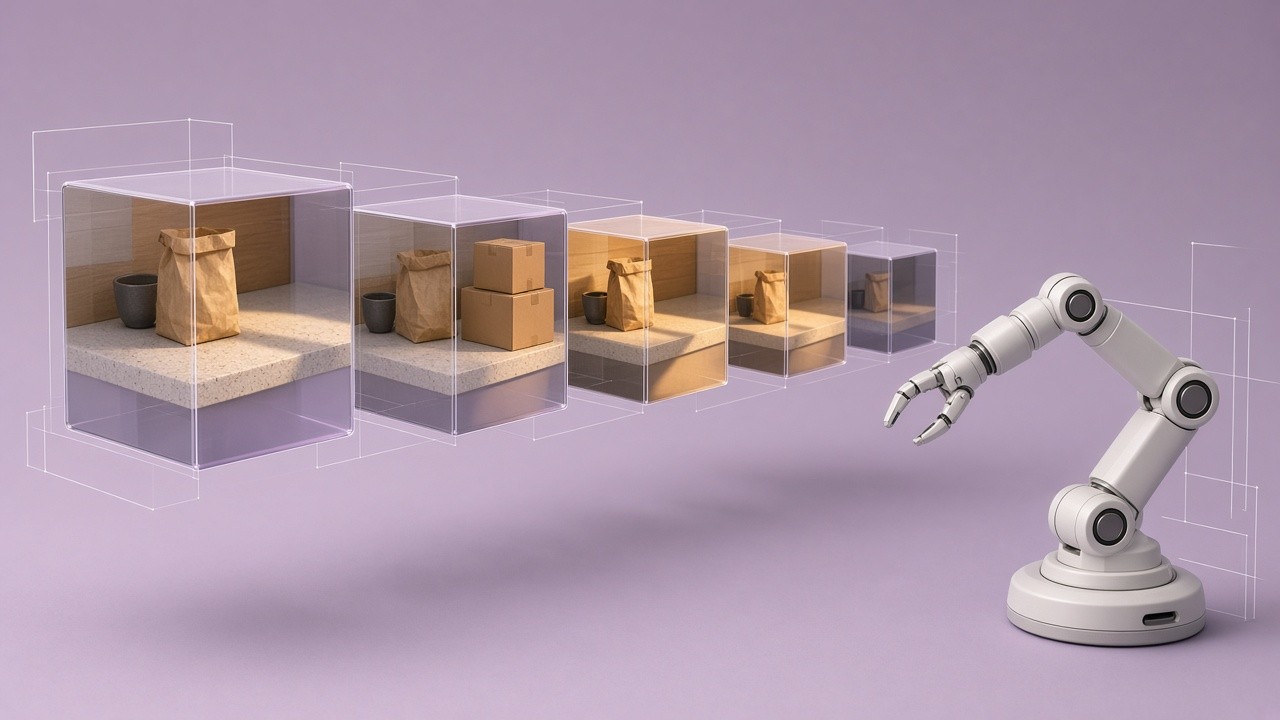
Physicl has raised a $10 million seed round to build synthetic training worlds for physical AI, and it has launched Studio, an app that recreates the specific situations a robot or world model gets wrong and then generates thousands of labeled variations of them. Inovia Capital led the round, announced on November 6, 2026, with US Venture Partners participating. The money funds teams in Paris and the San Francisco Bay Area, along with the platform behind Studio.
Founder and CEO Alex de Vigan frames the company around a gap at the end of robotics development. A robot that works nine times out of ten makes a good demo, but it cannot be deployed in a kitchen, warehouse, or hospital where every tenth run fails. The last stretch of reliability, he writes, depends on rare moments: a cup half hidden by a bag, a shadow crossing the counter at sunset, a box stacked slightly off. Those moments are hard to capture in the real world, and once caught they cannot be replayed or varied.
From retail 3D to robot training data
De Vigan spent the previous decade digitizing products and rooms in 3D for large retailers, building a library of real objects and the software to vary them. He says robotics labs, world-model labs, and vision teams started calling with a different request. They did not want better-looking images. They wanted the exact situations their models failed in, labeled on every pixel, thousands of times. Physicl’s bet is that physical worlds cannot be scraped from the internet the way text and images were. Instead, they have to be built from known geometry and physics, so that every label is exact and every condition can be changed on purpose.
What Studio does
Studio is Physicl’s first app. A researcher describes or recreates a scene the model handles badly, generates as many versions as training needs, and exports images or video with ground truth attached. The company highlights three features.
First, labels are exact because they come from the scene itself rather than being estimated from a picture afterward. That covers depth, surface normals, segmentation, bounding boxes, and camera pose. Physicl says those labels stay correct in dark corners and behind clutter, which is exactly where models fail.
Second, conditions can be changed one at a time or together: lighting, clutter, camera, or objects. That lets a model see every version of a rare case before it meets one in the field. One demo re-arranges a single room 16 times along one camera path, changing the furniture, clutter, and daylight while the camera stays fixed.
Third, the library is large from day one, with 10,000 environments and 100,000 underlying assets built from real geometry with known materials.
Studio is in beta and opening to research teams in waves. It is free during the beta for labs, universities, and companies building vision, world-model, and robotics systems.
Early proof point and backers
The company points to one early result. SpAItial, which builds world models that turn real rooms into explorable 3D scenes, trained with Physicl data and more than halved its reconstruction error on real rooms, according to an evaluation by Matthias Niessner’s team at the Technical University of Munich. Niessner, who is also SpAItial’s CEO, says the data changes what a small team can build in physical AI. He also sits on Physicl’s advisory board, alongside Thomas Wolf of Hugging Face, Christoph Lassner of World Labs, Yaser Sheikh, and Sébastien Deguy.
Inovia partner Steve Woods calls physical AI one of the largest emerging opportunities in technology, but says the industry still struggles to turn model capability into real-world performance. Physicl, he says, is going after scalable, physics-grounded data, which is one piece of that problem.
Physicl enters a busy field of companies supplying training data to robot and world-model builders, and it is starting with the hard edge cases rather than bulk data. Whether exact synthetic labels carry over to real-world robot performance at scale is still the open question. For now, the SpAItial result is the only customer figure the company has made public.
- #Physicl
- #Physical AI
- #Robotics
- #Synthetic Data
- #Seed Funding

Author
Raj M
Contributor
AI Systems Architect is a seasoned technology leader with over 15 years of experience in the IT industry working with Fortune 500 companies. With a solid foundation in multi-agent systems, open-source LLM infrastructure, and enterprise deployment, he excels at building scalable production-grade AI platforms.