
AutoTrust’s JEV-27B Serves Calibrated Decisions and Untouched Qwen Reasoning From One Engine
AutoTrust AI released autotrust/JEV-27B under Apache-2.0—an open-weights Blocks-of-Experts model that adds a LoRA decision head for System-1 typed answers while keeping Qwen3.8-27B generation byte-identical for System-2 reasoning.
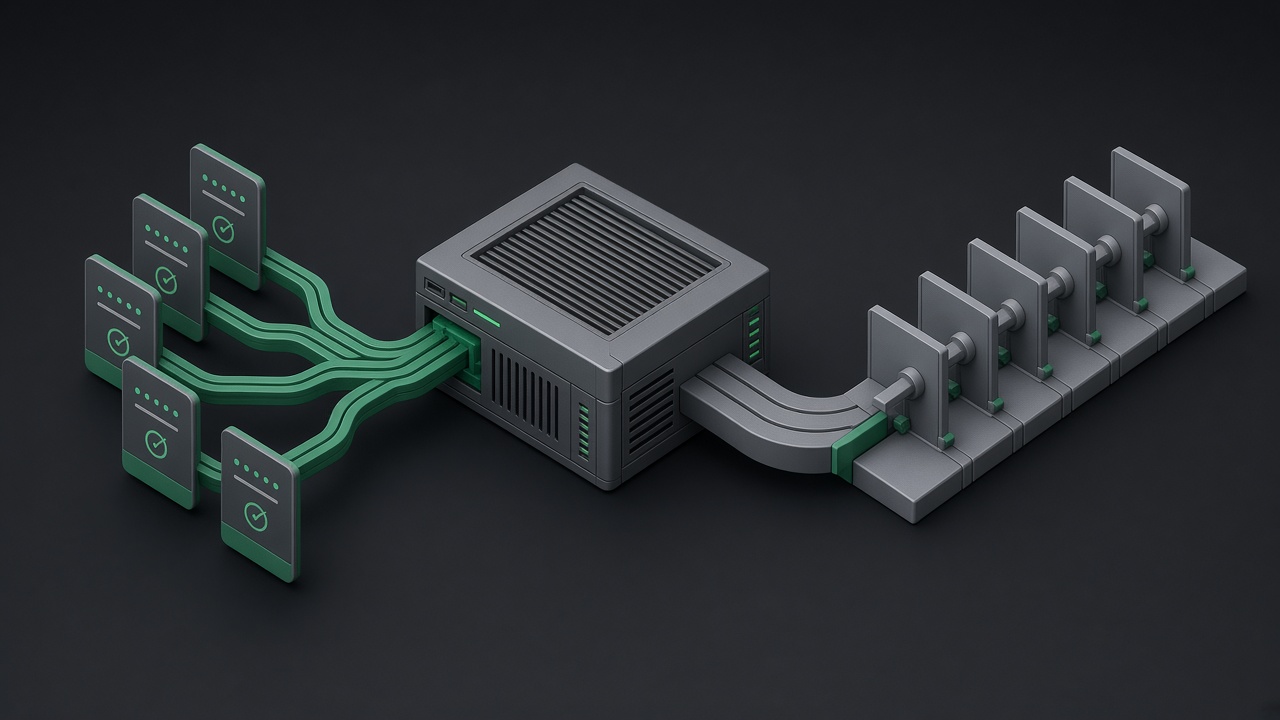
AutoTrust AI released autotrust/JEV-27B, an Apache-2.0 open-weights model that answers high-frequency typed decisions with calibrated probabilities while serving an untouched Qwen3.8-27B path for ordinary generation and step-by-step reasoning from one vLLM engine. The Hugging Face community blog detailing the release is dated September 27, 2026 and points to Hub weights, the decision adapter, training and serving code, vLLM support, evaluation reports, and a demo Space at autotrust/JEV-27B-Demo. AutoTrust states it is not affiliated with TypeSafe AI and shares no weights or code with the closed TypeSafe Jev 1.13 teacher whose output distributions were used for distillation.
Agents make many small decisions that do not need a long chain of thought: is this email phishing, which team owns the ticket, does this diff break a rule, how urgent is the request on a 0–5 scale. Those calls need a fast, thresholdable probability, not a paragraph. JEV-27B answers three typed primitives in one forward pass—noul (true/false), choice (2–16 options), and score (0–5 distribution plus expected score)—with no decoding, JSON parsing, or prompt engineering beyond the structured decision prompt. AutoTrust’s own runs of both models on six public decision benchmarks put JEV-27B at a mean 84.07 versus 83.85 for hosted TypeSafe Jev 1.13, ahead on four of the six groups.
The training recipe is called Blocks of Experts. The backbone is the frozen Qwen/Qwen3.8-27B text blob, bit-identical to the release. System 2 is the original lm_head for generation and thinking mode. System 1 is a LoRA of rank 16 (about 108.8 million trained parameters) plus a 24-slot fp32 decision head (about 123 thousand parameters), trained for roughly 9.2 hours on one B200 from the Apache-2.0 corpus SargeDev/jev-distill-corpus-v3. Merging LoRA into the backbone is deliberately avoided: on AutoTrust’s earlier 9B generation, merging cut HumanEval from 70.7% to 61.6%. On JEV-27B, HumanEval stays 78.0% (128/164) with and without System 1, and all 164 completions are reported byte-identical to the base model. In vLLM, the decision head is re-expressed as a LoRA on lm_head so a decision is a one-token completion constrained to verbalizer ids, read back as log-probabilities; chat requests use the untouched head and can share a batch.
Distribution-level fidelity is part of the claim, not only top-1 accuracy. On 25,376 held-out questions labeled with TypeSafe Jev’s own output distributions across 53 domains, mean KL(Jev ‖ JEV-27B) is about 0.017—roughly sixty sampled decisions to gather one nat of evidence about which model produced them. Expected calibration error is reported at 0.0009 with fitted temperatures near 1.00. On the independent gazelle93/decision-models-under-pressure set (human gold labels, none in training), JEV-27B reaches about 96–98% of Jev’s accuracy across 2/4/8/16-option settings. The blog is also clear about inheritance: JEV-27B copies teacher mistakes, including option-order sensitivity near 7% at 16 options and known weaknesses in multi-hop reasoning, arithmetic, counting, and adversarial inputs.
Serving numbers focus on self-hosting. AutoTrust reports a median 137 ms per decision on one B200 versus 238–301 ms third-party measurements for the hosted API, about 100 decisions per second and roughly 64 concurrent System-2 chats on one H100 80 GB at full bf16 without quantization, and matching decisions when moved from a B300 to that H100. A ready path is hf download autotrust/JEV-27B (~54 GB) plus vllm serve with --enable-lora, the jev-decision module, processed logprobs, and Qwen3 reasoning/tool parsers. A smaller sibling, autotrust/JEV-9B, remains for tighter GPUs. Suggested production pattern: let System 1 answer when confident and escalate to System 2 in the same engine—thresholds chosen on your data, not claimed as a benchmarked product feature.
For Writeble’s opensource desk, JEV-27B is the self-hosted answer to closed System-1 decision APIs that still keeps a full reasoning model in the same process—with Apache-2.0 weights teams can audit.
- #Open Source
- #Decision Models
- #AI Agents
- #Hugging Face
- #AutoTrust

Author
Raj M
Contributor
AI Systems Architect is a seasoned technology leader with over 15 years of experience in the IT industry working with Fortune 500 companies. With a solid foundation in multi-agent systems, open-source LLM infrastructure, and enterprise deployment, he excels at building scalable production-grade AI platforms.