
Black Forest Labs’ FLUX 3 Action Puts a 7B World-Action Policy on the Hub
Black Forest Labs released FLUX 3 Action, an open-weight 7B world-action model for robot control that jointly predicts video and actions, with DROID and SO-101 checkpoints on Hugging Face under the FLUX Kommunity License.
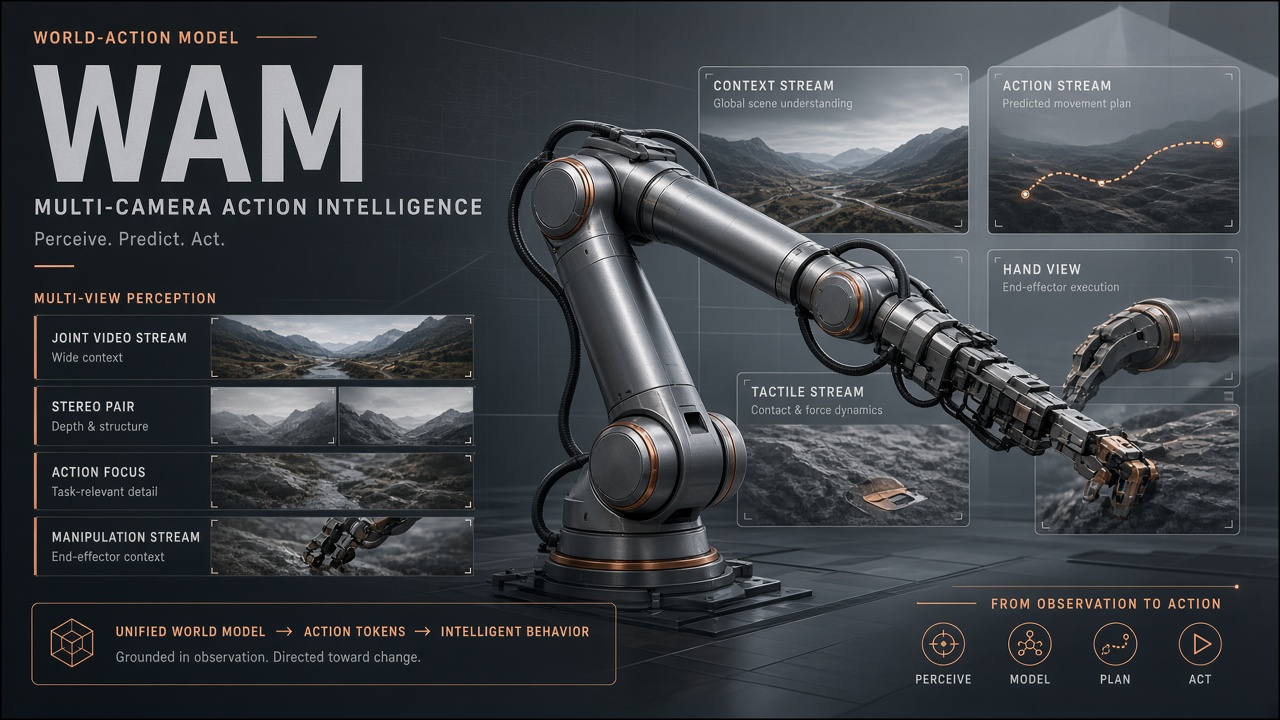
Black Forest Labs published FLUX 3 Action as an open-weight 7B world-action model for robot control, with company documentation dated September 2026 and ready-to-run DROID and SO-101 policies plus a shared adaptation base on Hugging Face. The model takes multi-camera frames, robot state, and a text instruction, then jointly denoises the next chunk of motor commands with predicted future video frames—a World Action Model (WAM) design rather than a vision-language-action head that emits actions alone. Model cards list the weights under the FLUX Kommunity License v1.0 (not Apache or MIT), with the bundled Qwen3-VL-4B text encoder remaining Apache 2.0 and the companion flux-action code carrying its own license.
BFL’s technical report positions the release against a familiar robotics trade-off. WAMs that predict video and actions together tend to lead simulation leaderboards but run slow; smaller VLAs are faster but leave success on the table. On RoboLab-120, FLUX 3 Action’s guidance-distilled checkpoint reaches about 42.2%–42.9% success at 7B parameters, ahead of Cosmos 3 Nano Policy’s 36.8% at roughly 16B and π0.5’s 28.0% at 3.3B, while step-distilled and FP8 serving paths reclaim latency. Company measurements claim up to about 3.95× speedup over Cosmos 3 Nano in FP8 across consumer, workstation, and datacenter GPUs depending on recipe, and a longer action horizon of about 2.13 seconds of motion per prediction versus 1.0 second for π0.5 at 15 Hz control.
Training follows a staged recipe the report publishes in unusual detail: multimodal Self-Flow pretraining dominated by video tokens, action-focused midtraining that mixes gaming, egocentric hands, handheld grippers, and teleoperation across fourteen embodiments into an EE50-style action space, then DROID finetuning with careful learning-rate warmups for newly initialized joint heads. Distillation removes the second guidance pass and can collapse sampling to a single step. Split classifier-free guidance favors high video guidance and low action guidance (the preferred setting cited is video CFG 4.0 and action CFG 1.0). EMA variants, including Power EMA, are treated as first-class for both performance and fair ablations.
Real-robot and hybrid results round out the claim. An independent Positronic Robotics evaluation on a Franka arm across ten DROID tasks (three attempts each, 240-second windows, operator blinded to model identity) recorded 28 of 30 successes for FLUX 3 Action versus 27/30 for Cosmos 3 Nano, 20/30 for DreamZero, and 13/30 for π0.5. Hybrid experiments that let GPT 6 Astra delegate to a fast policy show the efficiency story: with F3A as the local controller at low reasoning effort, the report cites about $8.77 and roughly eight minutes per success at 90% success, versus higher cost and latency for π0.5 hybrids or pure reasoning—while remaining clear that pure maximum-effort reasoning still tops accuracy on the hardest tasks.
Hugging Face packaging is practical for labs already on LeRobot. black-forest-labs/flux-3-action-droid loads via Flux3Policy.from_pretrained; the base repository supplies shared video VAE and text-encoder tensors for new embodiment heads; SO-101 finetunes demonstrate in- and out-of-distribution rollouts. Optimization subfolders cover guidance-distilled and step-distilled BF16/FP8 variants. Hardware notes put BF16 near 32 GB on an H200 and FP8 with text-encoder offload onto 24 GB cards. Safety language on the cards is blunt: outputs are joint targets without built-in velocity, force, or workspace bounds; applications must keep a hardware stop within reach and must not use the model for unsupervised control that endangers people.
For Writeble’s products desk, FLUX 3 Action is a September robotics drop that is concrete enough to evaluate and honest enough about licensing. It is open-weight and LeRobot-loadable, not an OSI-permissive Apache base the way some ungated research checkpoints are; teams should read the Kommunity terms before commercial redistribution. For research and local robot stacks that need a fast WAM with published DROID metrics, hybrid cost tables, and embodiment recipes, the Hub collection plus BFL’s September report now give a named 7B checkpoint to put on the RoboLab and Franka queues.
- #Robotics
- #World Models
- #Open Weights

Author
Raj M
Contributor
AI Systems Architect is a seasoned technology leader with over 15 years of experience in the IT industry working with Fortune 500 companies. With a solid foundation in multi-agent systems, open-source LLM infrastructure, and enterprise deployment, he excels at building scalable production-grade AI platforms.