
Google Research Open-Sources ToolGrad for Answer-First Tool-Use Dataset Generation
Google Research’s ToolGrad framework builds verified tool-use chains before writing user queries, shipping Apache 2.0 code plus the ToolGrad-500 dataset and Gemma-3 fine-tunes that the authors report near frontier BFCL scores.
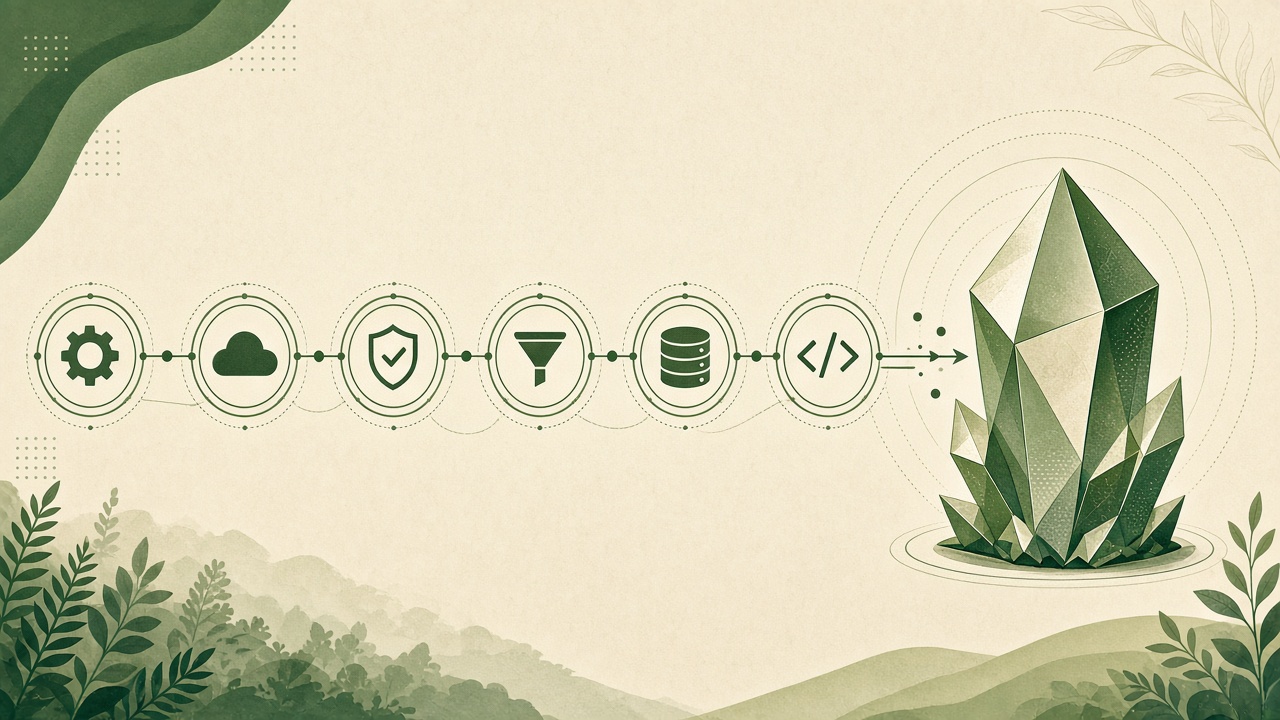
Google Research published ToolGrad on September 10, 2026, an agentic framework that inverts the usual tool-use dataset pipeline: it constructs a working API chain first, then synthesizes the matching user query. The ACL 2026 Findings paper and Google Research blog describe Apache-2.0 code on GitHub (zhongyi-zhou/toolgrad), a Hugging Face ToolGrad-500 dataset, and Gemma-3 1B, 4B, and 12B fine-tunes.
Prior pipelines such as ToolBench and ToolACE sample APIs, invent a user instruction, then search for a satisfying tool path—often failing and wasting exploration. ToolGrad’s four-module loop proposes candidate APIs, executes them in parallel, selects the best call as a textual “gradient,” and rewrites the synthetic query and response to match the growing chain.
Efficiency and BFCL results
On ToolBench’s 16,000-plus API database, the authors report ToolGrad raising generation pass rate from 63.8% (DFS baseline) to 99.8%, lengthening ground-truth tool uses per sample from 2.1 to 3.4 while cutting tool-use steps from 34.3 to 20.0. Marktechpost’s September 10 write-up restates the same author figures and notes a PyPI toolgrad package.
Fine-tuning Gemma-3 on ToolGrad-500 (built with Gemini 2.5 Flash-Lite) produced ToolGrad-12B at 83.1 on the Berkeley Function Calling Leaderboard in the authors’ OOD evaluation—next to Gemini 2.5 Pro at 83.2 and ahead of several open tool-use specialists at publication time. Label those leaderboard numbers as author-reported.
Primary sources are Google Research’s September 10 blog post, Marktechpost’s same-day brief, and the Apache-2.0 GitHub repository with linked Hugging Face dataset and model cards.
- #Opensource
- #AI Agents

Author
Raj M
Contributor
AI Systems Architect is a seasoned technology leader with over 15 years of experience in the IT industry working with Fortune 500 companies. With a solid foundation in multi-agent systems, open-source LLM infrastructure, and enterprise deployment, he excels at building scalable production-grade AI platforms.