
NVIDIA Open-Sources PAIR to Route Local AI Inference Across RTX, DGX Spark, and Mac Nodes
NVIDIA Personal AI Router (PAIR) is an Apache 2.0 virtual inference router that discovers home-network machines and spreads independent Ollama or LM Studio requests across them, cutting a five-subagent Hermes demo from 18 minutes to 8:48 on a three-device cluster.
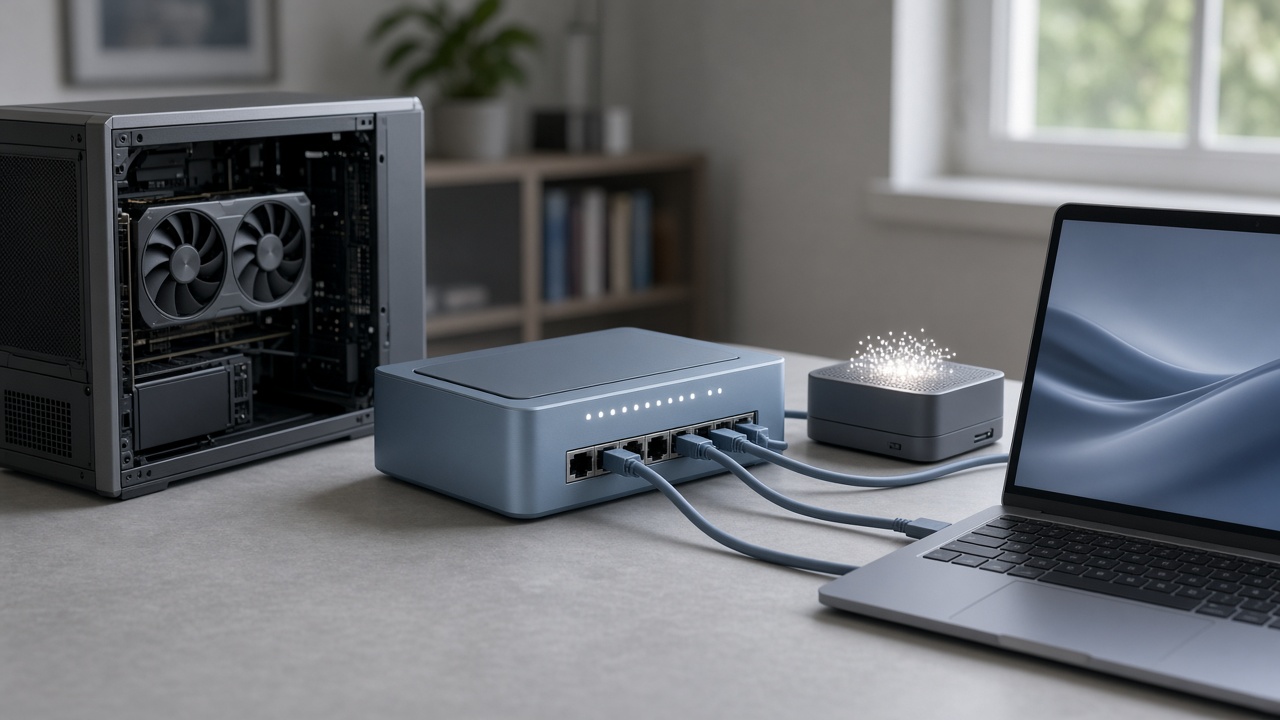
NVIDIA released Personal AI Router (PAIR), an open-source virtual inference router that discovers compatible machines on a local network and schedules independent inference requests across them. NVIDIA’s technical blog is dated September 3, 2026; Marktechpost covered the public beta on September 4. PAIR is not a new engine—Ollama or LM Studio still runs the model on whichever node the router selects.
Multi-agent workflows turn one user task into many concurrent model calls. Pointed at a single local engine, those calls queue while other GPUs on the same network sit idle. PAIR widens the inference layer without forcing harness changes: it proxies the Ollama-compatible and LM Studio-compatible interfaces agents already use, taking over each engine’s default port (or a configured proxy port) and also exposing OpenAI-compatible proxy endpoints.
Discovery, trust, and scheduling
PAIR finds nearby systems with mDNS and can add a node by IP when discovery fails. Trust uses a six-digit PIN on the inviting machine; node-to-node traffic is blocked until pairing completes, then secured with mTLS and generated certificates. Each node runs Ollama or LM Studio. PAIR can help install an engine and start model downloads on paired systems.
A node is eligible only when the required engine is enabled and the exact requested model is present. Models need not match across the cluster; PAIR routes by model location. For each request the scheduler weighs readiness, engine state, model presence, job load, and GPU utilization. Assignment is workload-level concurrency: each request stays on one eligible node for its lifetime. PAIR does not pool VRAM, merge GPUs, or shard a single request across machines.
Demo numbers and hardware
In an unofficial Hermes Desktop demonstration, a five-subagent inbox-planning workload ran Qwen 3.6 35B A3B through Ollama. On one RTX Spark laptop the run averaged 18 minutes. On a three-device PAIR cluster (RTX Spark laptop, DGX Spark, and an RTX 5090) it averaged 8 minutes and 48 seconds. NVIDIA stresses the figures are configuration-specific, not a general benchmark or a promise of linear scaling.
Supported hardware includes GeForce RTX 20 Series and newer, RTX PRO workstation GPUs from Turing onward, DGX Spark, and Apple M4 or newer silicon. Windows, Linux, and macOS nodes can pair across x64 and arm64, with Windows on ARM experimental. Validated setups list 8 GB RAM or higher and about 20 GB of disk. Marktechpost reports the public beta as v0.1.1 under Apache 2.0 with signed installers for Windows, macOS, and Linux. Primary sources are NVIDIA’s PAIR technical blog and Marktechpost’s September 4 briefing.
- #Opensource
- #AI Agents
- #AI Infrastructure

Author
Raj M
Contributor
AI Systems Architect is a seasoned technology leader with over 15 years of experience in the IT industry working with Fortune 500 companies. With a solid foundation in multi-agent systems, open-source LLM infrastructure, and enterprise deployment, he excels at building scalable production-grade AI platforms.