
K-Dense-AI Releases Scientific Agent Skills Library Across 100 Biological and Chemical Databases
K-Dense-AI released scientific-agent-skills on GitHub, reaching 34,871 total stars and trending on August 27, 2026. The repository compiles 163 verified operational skills and connectors for over 100 scientific databases covering genomics, medicinal chemistry, and drug discovery workflows. The skill definitions conform to the open Agent Skills standard and support execution across Cursor, Codex, Claude Code, and Pi.
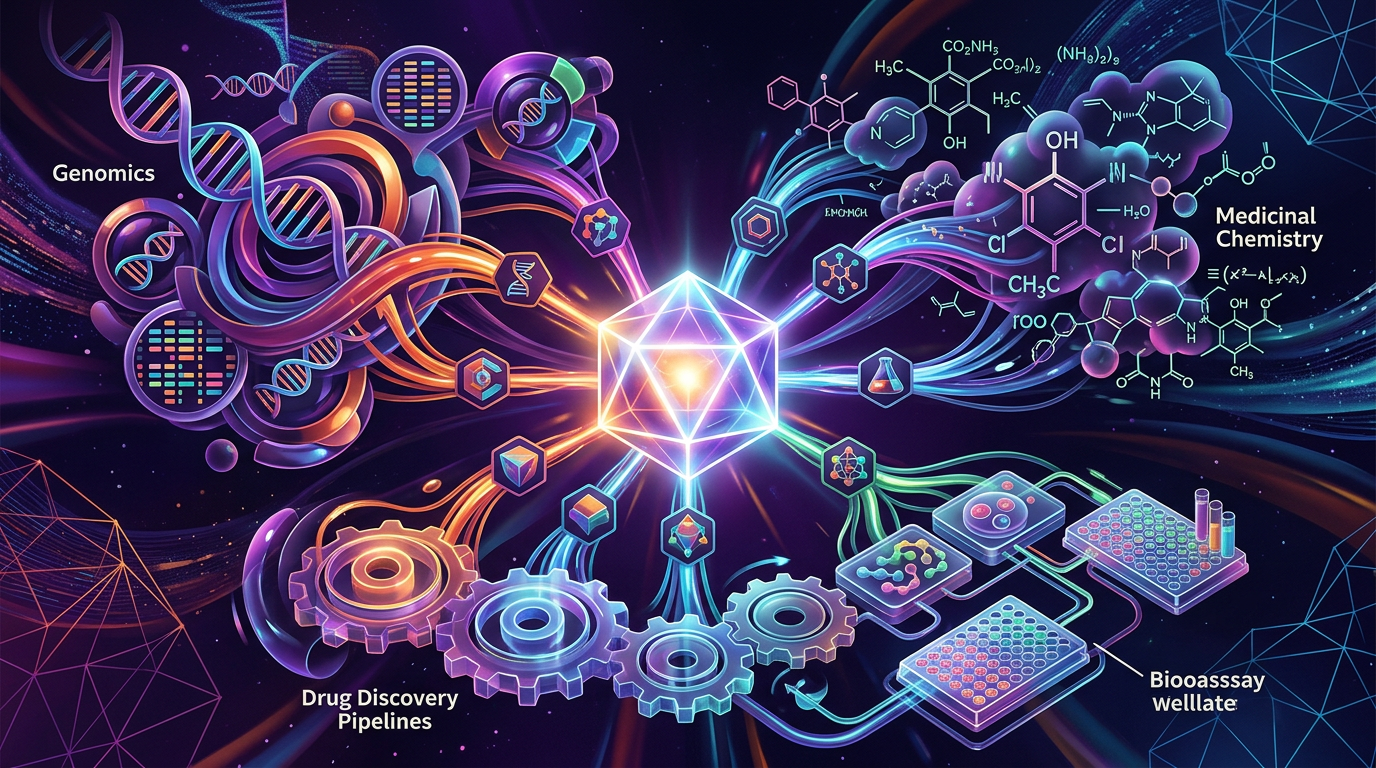
Open-source repository scientific-agent-skills reached 34,871 stars on GitHub after trending on August 27, 2026, following its release by K-Dense-AI. The collection bundles 163 verified operational skills and database connectors covering genomics, medicinal chemistry, and drug discovery pipelines, standardizing how autonomous software agents interact with scientific repositories across environments such as Cursor, Codex, Claude Code, and Pi.
Structured Guidance for Computational Biology and Chemistry Workflows
Automated research agents rely on domain-specific context and tool execution routines to interact with specialized life science datasets. Without curated instructions, large language models navigating biological and chemical databases often encounter syntax errors, generate malformed API queries, misinterpret specialized file formats, or misidentify gene and chemical notations.
The scientific-agent-skills repository addresses these operational challenges by supplying 163 self-contained skill packages tailored for automated biological and chemical computing. Rather than requiring models to infer complex life-science workflows from scratch, the skills furnish agents with procedural instructions, usage patterns, and reference execution scripts.
The library organizes its capabilities across three primary scientific domains:
- Genomics: Skills for querying nucleotide sequences, parsing genomic coordinate files, retrieving gene expression profiles, and gathering variant annotations across reference genomes.
- Medicinal Chemistry: Workflows to calculate physicochemical properties and molecular descriptors, convert between chemical notation formats such as SMILES and InChI, and verify chemical structure representations.
- Drug Discovery Pipelines: Multi-step routines for cross-referencing target binding affinities, screening candidate compound libraries against assay endpoints, and extracting preclinical evaluation data.
Each skill provides context-aware guidance and step-by-step procedures that guide the language model through complex domain rules, reducing formatting errors and failed executions during multi-stage computational pipelines.
Standardized Interoperability for Over 100 Scientific Databases
Life science repositories utilize diverse access mechanisms, ranging from REST endpoints and SOAP interfaces to SPARQL endpoints and direct SQL feeds. Writing bespoke connection logic for individual databases frequently slows the setup of automated research workflows.
The repository includes pre-built connectors for more than 100 scientific databases. These connectors supply the exact query syntax, endpoint definitions, authentication conventions, and pagination logic needed to interact with external biological and chemical resources.
When an agent needs to map a target protein to known chemical inhibitors, it consults the relevant skill documentation and accompanying scripts. The skill outlines the exact network endpoints, header requirements, and payload structures needed to fetch data efficiently, helping the model avoid repetitive trial-and-error queries.
The connectors also provide guidance on filtering response payloads. By directing agents to extract targeted data fields before processing, the skills minimize context-window bloat during high-throughput database queries.
Conformance to the Open Agent Skills Specification
All 163 capabilities in the library follow the open Agent Skills specification. Under this standard, skills are structured as modular directories centered on SKILL.md files. Each file combines YAML frontmatter—defining metadata like the skill’s name and description—with Markdown documentation that contains detailed operational guidance, environment prerequisites, and recommended execution workflows.
---
name: query-compound-assay
description: Retrieves bioassay results for a target compound identifier and protein target.
---

# Query Compound Assay

## Overview
Queries bioactivity databases to retrieve binding affinity, IC50 values, and assay readouts for specified small molecules.

## Guidelines
1. Normalize input compound representations to standard SMILES or InChIKey format.
2. Resolve target proteins using standard UniProt accession numbers or gene symbols.
3. Use the packaged query script to retrieve bioassay endpoints with pagination.

## Example Script
```python
from bio_connectors import fetch_assay_data

results = fetch_assay_data(
    compound_id="CHEMBL25",
    target_protein="P00533"
)
Because instructions are provided in readable Markdown alongside optional helper scripts, agents can load skills directly into their context window when needed. This approach eliminates the need for proprietary middleware or custom wrapper frameworks, allowing agents to read standard documentation, follow documented procedural best practices, and invoke relevant helper scripts directly.

## Cross-Platform Execution Across Developer Environments

Because the repository relies on the vendor-neutral Agent Skills standard, the skill definitions can be consumed by multiple AI development environments and terminal tools without modification. The project documents support across four major developer platforms:

* **Cursor:** Developers working inside the editor can load skills to automate computational chemistry checks and fetch genomic reference records directly during development.
* **Codex:** Code generation workflows can reference skill directories to generate accurate domain-specific API calls and tests.
* **Claude Code:** Terminal-based agents can navigate the skills repository to run automated biological data extraction and processing pipelines from the command line.
* **Pi:** Autonomous agent runtimes can import the skills to conduct continuous literature sweeps and multi-database research queries.

The repository reached its total of 34,871 GitHub stars following its trending status on August 27, 2026, with the full library of 163 skills and 100 database connectors available under its open-source release.- #GitHub Trending

Author
Raman V
Contributor
Enterprise Solutions Leader is a transformation expert with over 15 years of experience in the IT industry working with Fortune 500 companies. With a solid foundation in large-scale application development and enterprise modernization, he excels at architecting robust, scalable platforms that drive operational efficiency.